
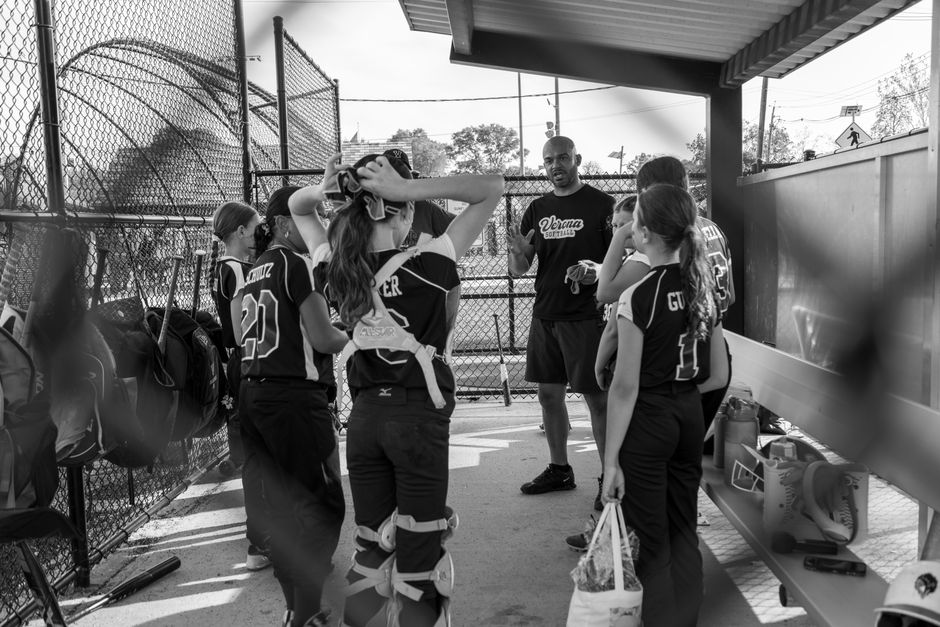
A dad asked me at pickup last month what his 9-year-old was actually going to learn this year, because from the bleachers it just looked like a lot of standing around between drills. Fair question. Here is the honest answer.
The Feeder Program exists for one reason: ages 8 to 10 are when habits form, good ones and bad ones, and almost nobody is coaching that age group with any real intention. Most programs either park young players in scaled-down scrimmages or drill them like they are already 14. Neither one builds the foundation that actually matters later.
Throwing Mechanics, Not Just Throwing
At this age we are not chasing velocity. We are building a throwing motion that will not need to be rebuilt at 13 — proper grip, footwork, and arm path repeated enough times that it becomes automatic rather than something she has to think about mid-game. Rebuilding a bad throwing habit at 13 is a real thing, and it is avoidable.
Catching the Ball Before Catching a Position
Every player in the Feeder Program works on catching fundamentals regardless of what position she eventually plays — glove work, footwork on ground balls, tracking the ball into the glove instead of at it. Position specialization comes later. At 8 to 10, the goal is a player who is comfortable and confident with the ball coming at her from any angle.
Game Understanding, Not Just Game Reps
We spend real practice time on situational awareness — where does this throw go, why, what happens if it is a ground ball versus a fly ball with a runner on. Most 8-to-10 scrimmage-heavy programs skip this because it is less visually exciting than live at-bats. We do not skip it, because a player who understands the game develops faster once the physical skills catch up.
What a Typical Week Looks Like at Clubhouse 220
Practices are built around short, focused stations rather than long unstructured blocks — attention spans at this age are real, and twenty focused minutes on a skill beats sixty distracted ones. Coaches rotate players through throwing, fielding, and hitting stations with actual feedback at each one, not just repetition for its own sake.
Coaches Who Have Actually Done This
Several of the people running Feeder Program sessions came up through this club themselves and came back to coach it — not as a resume line, but because they remember exactly what it felt like to be 9 and either get real instruction or not get it. That matters more than it sounds like it should. A coach who has actually played travel softball at a high level notices things a well-meaning parent-volunteer coach usually cannot: a subtle flaw in a throwing motion before it becomes a habit, a kid who is checked out because a drill has gone on too long, the difference between a player who needs more reps and one who needs a different explanation entirely.
If you are trying to figure out whether this is the right starting point for your daughter, the lowest-pressure way to see it firsthand is one of our clinics — no commitment, just a real look at how a session actually runs. You can see the full program details on the Feeder Program page, meet the staff running it on our coaches page, or just reach out with questions — Clubhouse 220, 1284 Main St, East Hartford.
Diamond Softball Club — Development over drama. New England travel ball for players who actually want to get better.