
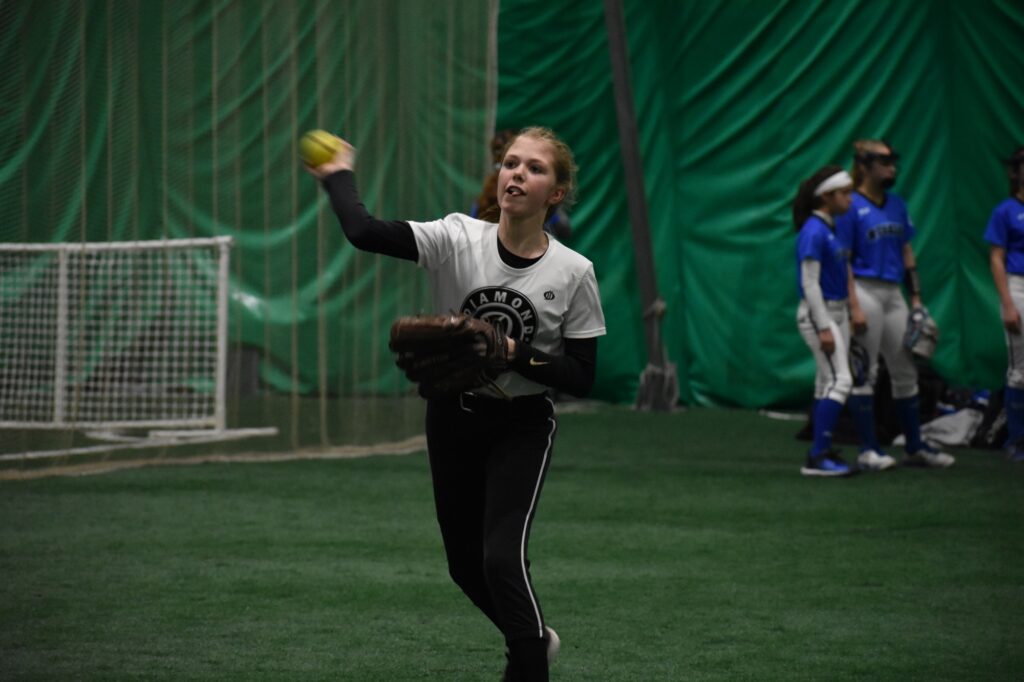
A mom stopped one of our coaches after a Saturday session with a worried look. Her daughter had grown two inches since summer, and her throws, which used to be on a line, were suddenly sailing over the first baseman’s head. “Did she forget how to throw?” she asked. She didn’t. Growth spurts and softball have a complicated relationship, and this post explains why her throwing can suddenly get worse, what it means for her body, and when to slow down.
Her Body Changed Faster Than Her Timing Did
Throwing is a timing skill. Every throw depends on her brain knowing exactly where her arm, hips and feet are and how long each piece takes to move. When her arms and legs get longer in a few months, all of that math changes at once. The release point she grooved last spring is now in a slightly different place, and her stride covers different ground. Nothing is wrong with her. She is relearning a movement inside a body that keeps changing, and that takes patience and reps.
Why Growth Spurts Are Also a Higher-Risk Window
Coordination is the part parents notice. The part they can’t see is happening at the ends of her bones. Kids have growth plates, areas of cartilage near the ends of long bones where new bone forms, and they are weaker than the bone around them. Children’s Hospital Colorado notes that during rapid growth, tendons and ligaments can get extra tight, and that repetitive motions like pitching are a common cause of overuse injuries to growth plates. For a softball player, that means the shoulder, elbow and knees are carrying more load at exactly the moment they are least ready for it.
What Backing Off Actually Looks Like
Backing off doesn’t mean shutting her down. It means fewer max-effort throws, shorter pitching sessions, and more attention to warm-ups and footwork. A growth spurt is a great time to rebuild mechanics slowly with short, controlled throws rather than long toss at full effort. It is also a bad time to add a second team or a pitching lesson every other day. If you want a framework for weekly volume, our training-load guide by age is a good place to start, and during a growth spurt we lean toward the lower end of it.
When to Stop Guessing and See Someone
Some soreness after a long practice is normal. Pain that shows up in the same spot every time she throws, pain that lingers into the next day, or pain that changes how she moves is not something to play through. The same goes for a sudden sharp pain during a hard throw or sprint. Talk to her pediatrician, and ask whether a pediatric sports medicine specialist makes sense. We are coaches, not doctors, and we would always rather a player miss a week than miss a season.
How We Handle It at Diamond
Our coaches expect growth spurts, especially as players move through the 10U and 12U years, so we plan for them. When a player’s throws start sailing, we don’t treat it as a confidence problem or a work-ethic problem. We shorten her throwing, slow down her mechanics work, and check in with her and her parents about how her arm feels. Small groups make that possible, because a coach can notice a change in one athlete instead of managing a crowd. Our clinics work the same way, with individual attention built into every session.
If your daughter is in the middle of a growth spurt and her game suddenly feels off, give her some grace and give her body time. The skills are still there. They just need to catch up with her.
Diamond Softball Club — Development over drama. New England travel ball for players who actually want to get better.