
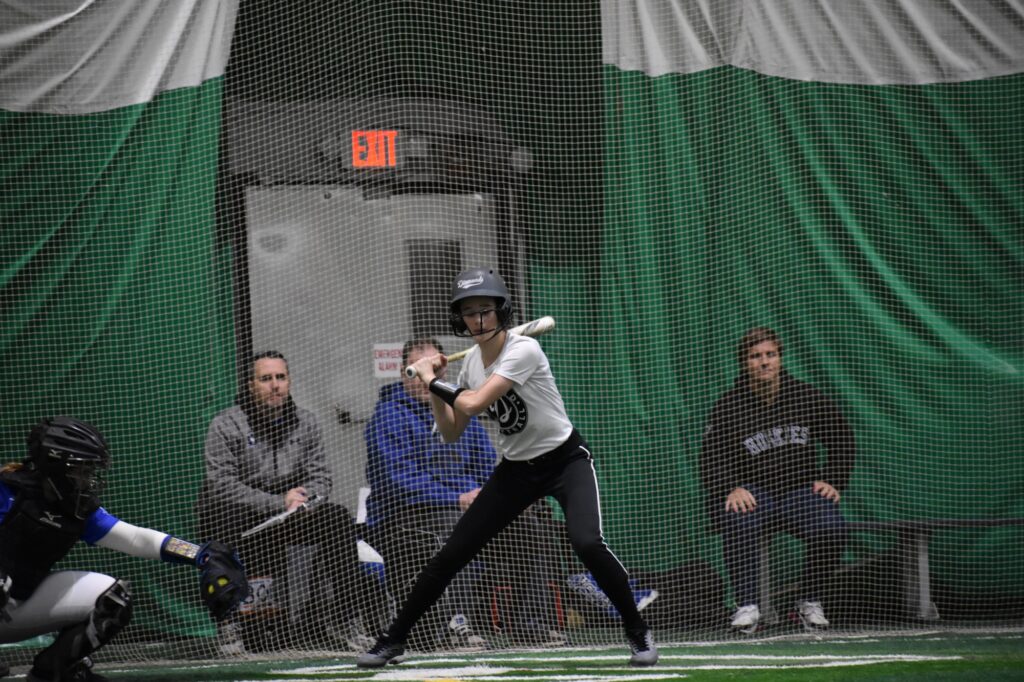
A dad asked one of our coaches at pickup how many swings his daughter should be taking in the cage this winter. He had a number in mind, and it was big. It’s a fair question, because indoor hitting is most of what a New England player can do between November and March. But the number of swings matters a lot less than what each swing is practicing. This post covers what makes cage work transfer to games, and what turns it into a long, loud way to build habits she’ll have to unlearn in April.
More Swings Isn’t the Same as Better Swings
Two hundred swings in an hour sounds productive. In practice, the last hundred are usually tired swings, and tired swings drop the barrel, cut short the finish and drift out of the legs. She is still getting reps, just reps of the wrong move. We would rather see 60 to 80 swings with a clear purpose and a short break between rounds than a bucket emptied as fast as possible. When her swings get sloppy, the session is done, even if the bucket isn’t.
Tee, Front Toss and the Machine Each Do a Different Job
The tee is for building the swing: where her hands start, how her hips lead, where contact happens. Front toss adds a moving ball without speed, so she can work on timing while keeping the mechanics she built on the tee. The pitching machine is for speed and seeing the ball, but it throws the same pitch at the same rhythm over and over, which no pitcher in a real game will do. A good cage session usually moves through all three in that order. Spending the whole hour on the machine is one of the most common winter mistakes we see.
Make Indoor Hitting Look Like a Game
Games don’t give her ten pitches in a row in the same spot. So once her swing is warm, mix it up: change the tee height between swings, call the location on front toss after she starts her load, or give her a count and a situation (“one strike, runner on second, hit it the other way”). Have her take some pitches too. Laying off a bad pitch is a skill. Every round should have a goal she can say out loud before she steps in.
Keep the Feedback Short
A hitter can only think about one thing during a swing. If she gets five corrections after every round, she will remember none of them. Pick one focus for the session and stick with it, and let her tell you what she felt before you tell her what you saw. Parents can do a lot of good at home with a bucket and a tee, as long as the feedback stays short and the mood stays light. If you want ideas for structuring the whole winter, not just the cage, our post on building a smarter off-season covers the bigger picture.
How We Run Cage Work at Diamond
Our winter hitting work happens at Clubhouse 220 in East Hartford, with full turf and cages, so the season doesn’t stop when the fields freeze. Every session has a plan, and we keep groups small so a coach can watch her swings instead of just counting them. We move from tee to front toss to live speed, give one clear focus per player, and end before quality drops. Our clinics follow that same structure and are open to any player, with no commitment.
If your daughter is heading into a winter of cage work, aim for fewer swings with more purpose. That’s what still shows up when she steps into a real batter’s box in the spring.
Diamond Softball Club — Development over drama. New England travel ball for players who actually want to get better.